
When to Use the GPA & GPA Planning Calculators
Use the GPA Calculator to estimate your grade point average from course grades and credit hours. Once your GPA is calculated, the GPA Planning Calculator uses that result to help estimate the GPA you would need across future credits to reach a target cumulative GPA. The two calculators are designed to work together: first, determine where your GPA stands now, then use the planning calculator to explore what grades and future credits may be needed to reach your target GPA.
GPA Scale Used
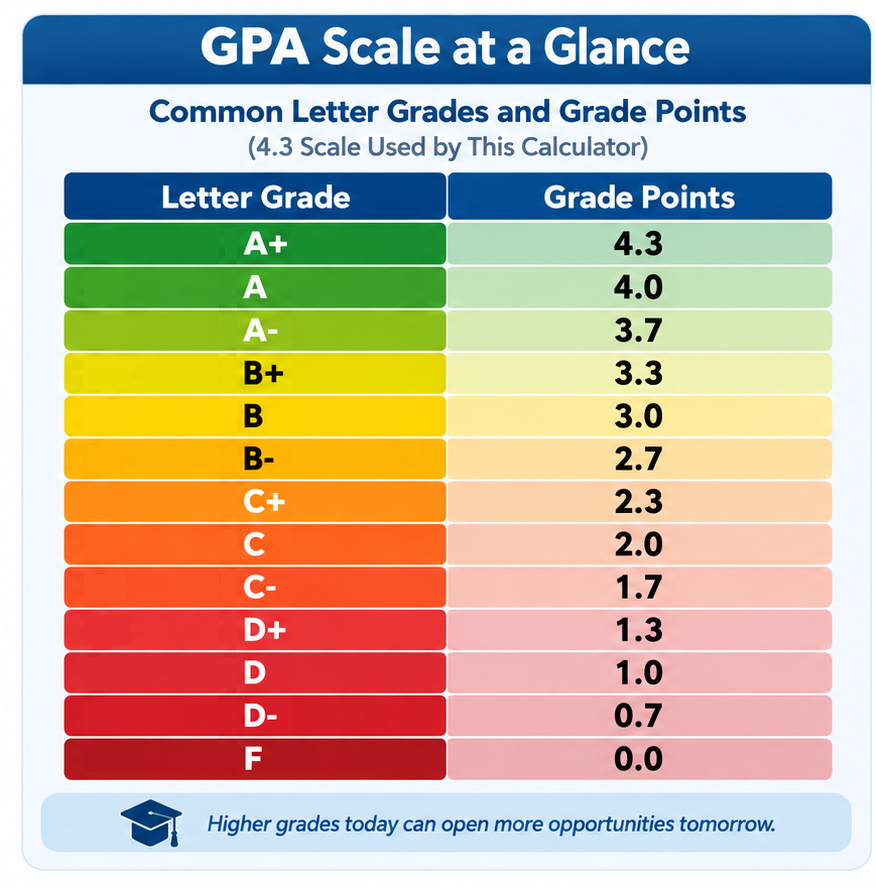
This GPA calculator uses the following letter grade values: A+ = 4.3, A = 4.0, A- = 3.7, B+ = 3.3, B = 3.0, B- = 2.7, C+ = 2.3, C = 2.0, C- = 1.7, D+ = 1.3, D = 1.0, D- = 0.7, F = 0.0. Pass, no-pass, incomplete, and withdrawal grades are not included in the calculation. The GPA Planning Calculator uses the same 4.3 grade scale when estimating the GPA needed across future credits.
How GPA Is Calculated
GPA is calculated by multiplying each course grade value by the number of credits for that course. Those grade points are added together and divided by the total number of credits. For example, a 3-credit course with an A contributes 12 grade points because 3 credits × 4.0 = 12. Your GPA is the total grade points divided by the total credits entered. The GPA Planning Calculator uses the same credit-weighted math to estimate the GPA you would need across additional credits to reach a target cumulative GPA.
Weighted GPA Example
Here is a simple weighted GPA example: Math: 3 credits × A / 4.0 = 12.0 grade points. Literature: 3 credits × A- / 3.7 = 11.1 grade points. History: 3 credits × B+ / 3.3 = 9.9 grade points. Total grade points: 33.0. Total credits: 9. GPA = 33.0 ÷ 9 = 3.67. This same GPA and credit total can then be used automatically by the GPA Planning Calculator as the starting point for a future GPA plan.
Planning for a Target GPA
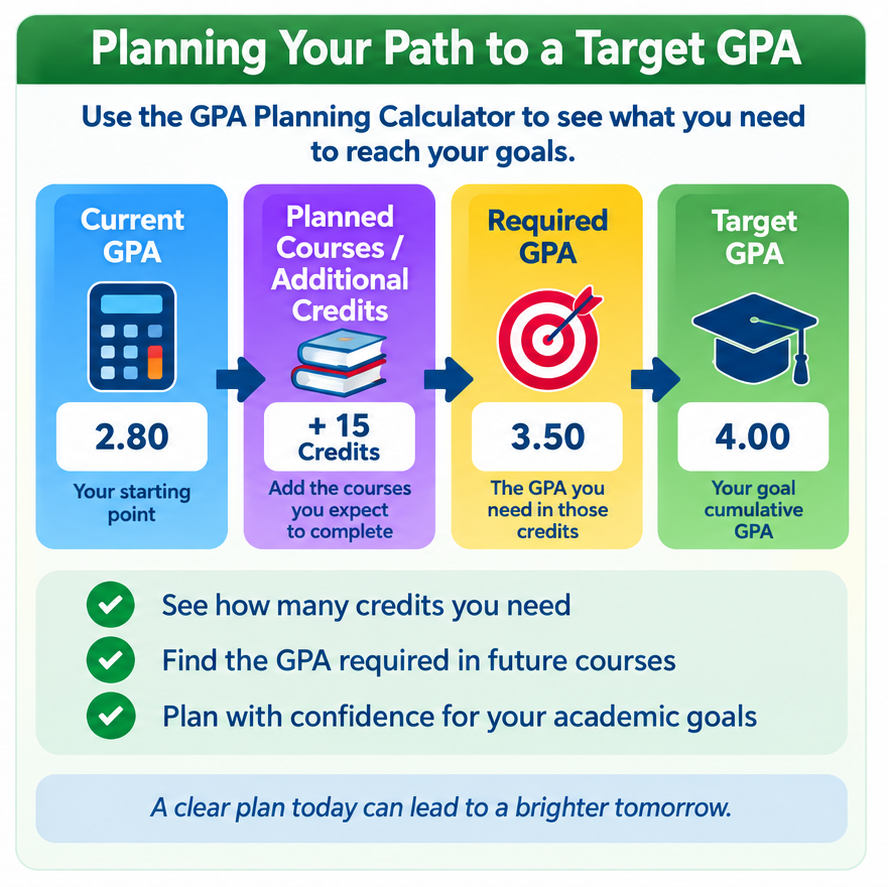
The GPA Planning Calculator uses the GPA and total credits from the GPA Calculator as its starting point. Current GPA and Current Credits are filled automatically, so you do not need to enter them again. Enter your Target GPA, the number of Planned Courses, and the Additional Credits you expect to complete, then select Calculate Plan. Planned Courses provides useful course-load context, while the GPA calculation itself is based on the number of additional credits entered.
Understanding Your Planning Result
The Planning Results panel shows the GPA you would need across the additional credits entered in order to reach your target cumulative GPA. It also summarizes your Current GPA, Current Credits, Target GPA, Planned Courses, and Additional Credits so you can review the assumptions behind the estimate. If the required future GPA would exceed the calculator’s 4.3 scale, the result will show Not possible and display the highest cumulative GPA that could be reached within the additional credits entered.
GPA and Planning Example
Suppose a student enters three 3-credit courses with grades of A, A-, and B+. The GPA Calculator returns a 3.67 GPA across 9 credits. The GPA Planning Calculator automatically uses those values as the student’s Current GPA and Current Credits. If the student enters a Target GPA of 4.00, 5 Planned Courses, and 15 Additional Credits, the Planning Results show that approximately a 4.20 GPA would be needed across those additional credits to reach the 4.00 cumulative target.
Tips for Raising Your GPA
Raising your GPA usually takes consistent effort over time. A few practical habits can be helpful: attend class regularly, keep track of assignments and due dates, ask questions when material is unclear, use tutoring or office hours when available, and focus extra time on courses with more credit hours because they have a larger effect on your final GPA. These calculators can help you understand how different grades and credits affect your average and explore how future coursework may influence a target GPA. Use the GPA Planning Calculator to compare different target GPAs and future credit loads so you can see how changes to your academic plan may affect the grades required. These tools do not replace academic advising. If you are trying to meet a scholarship, graduation, transfer, or admissions requirement, check with your school or advisor for the official GPA rules used by your institution.